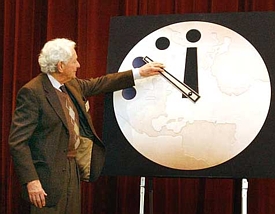
CHICAGO - The keepers of the ''Doomsday Clock'' on Wednesday advanced its hands nearer to the midnight hour symbolizing nuclear weapons conflict, its closest since the Cold War's end, citing worries over lagging disarmament efforts, the security of existing stockpiles and terrorism.
The directors of the Bulletin of the Atomic Scientists, a magazine that has campaigned for nuclear disarmament since 1947, pushed the hands forward by two minutes, to seven minutes to midnight.
It is the closest to midnight that the clock has been positioned since the end of the Cold War, but not as close as the record danger position -- two minutes to midnight -- in 1953 when the United States tested the first hydrogen bomb.
''Despite a campaign promise to rethink nuclear policy, the Bush administration has taken no significant steps to alter nuclear targeting policies or reduce the alert status of U.S. nuclear forces,'' said George Lopez, chairman of the Bulletin's Board of Directors.
''Meanwhile, domestic weapons laboratories continue working to refine existing warheads and design new weapons, with an emphasis on the ability to destroy deeply buried targets,'' he said.
Lopez said the directors also were ''deeply concerned that the international community appears to have ignored the wake-up call of Sept. 11. Terrorist efforts to acquire and use nuclear and biological weapons present a grave danger. But the U.S. preference for the use of preemptive force rather than diplomacy could be equally dangerous.''
The announcement cited what it said was a continuing U.S. preference for unilateral rather than cooperative action, and its efforts to impede international agreements designed to limit the proliferation of nuclear, biological and chemical weapons.
It criticized U.S. plans to walk away from the Antiballistic Missile Treaty in June, and its refusal to participate in talks regarding implementation of the Comprehensive Test Ban Treaty.
It also cited a general lack of progress on nuclear disarmament, growing concern about the security of nuclear weapons materials worldwide, and the crisis between nuclear-capable neighbors India and Pakistan. It said more than 31,000 nuclear weapons still are maintained by the eight known nuclear powers, a decrease of only 3,000 since 1998.
The new seven-minute mark is the same position at which the clock was set when it began appearing on the cover of the magazine in 1947. In addition to the magazine cover, the publication keeps an actual clock at its offices, and it repositioned those hands on Wednesday.
The hands last were moved in June 1998, from 14 minutes to nine minutes to midnight. The clock has been reset 16 times previously. After the collapse of the Soviet Union, the minute hand was pushed back to 17 minutes to midnight in 1991, completely out of the final 15-minute danger zone.
|