It is only in recent years that
the
technology has become available for people of moderate incomes to realize
the
dream of visual music. With this new technology has come innovation and
experimentation
in the field of visual music. However, the field itself is not new at all.
Theories
and methods regarding the use of image as an expressive medium have been
prevalent
in many cultures and time periods throughout recorded history.
What is Visual
Music?
Visual Music comes in many
flavors,
ranging from the abstract to the common place. Most general concepts of
visual
music suggest that visual performances can be composed of musical elements
and
musical structures. (Ron
Pellegrino, 1997) Such that, for instance, each musical note or phrase
has
a corresponding visual element, or simply that a live visual performance
can
be as expressive as a live audio performance.
In order for there to be visual
music,
there must be visual instruments. Instruments that allow the musician to
use
image as an expressive medium. In modern terms this would be a real-time
controllable
device that is both complex enough to allow expressive playing and
consistent
enough to make repeated performances possible.
Visual Music has many modern
day
manifestations. One common examples could be converting music to images
like
screen savers, which respond to sound, but do nothing apart from
synchronization
of sound and image. Visual
Music could also be expressing music in visual form, such as would require
the
active involvement of an artist to interpret the music; or Visual Music
could
be creating visual relationships which change over time. Which are not
necessarily
correspond to specific music notes or phrases, but rather express with
abstract
colors and shapes the same types of expression as is reached with
music.(Paul
Friedlander praskovi@clara.net)
Visual Music
History
This idea has been around
longer
that either the computer or the 'sound light converter' found in night
clubs.
Some famous people have speculated about this, Goethe for one, and
Beethoven
also was known to have produced a table of equivalence between musical key
and
color. Beethoven and Goethe did not agree as to which color corresponded
to
which key and the whole process of establishing a 'sound light'
relationship
is an ongoing and unfulfilled activity.(Paul
Friedlander praskovi@clara.net)
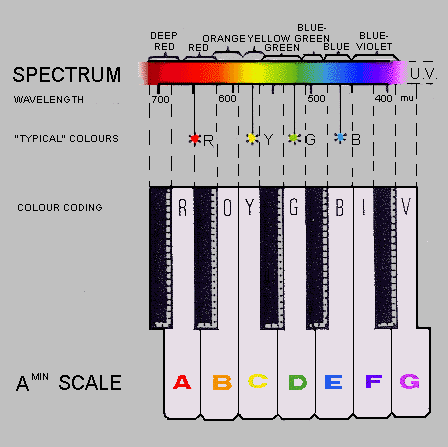
Division of the
spectrum
into eleven sections. A modification of the visual to auditory spectrum
proposed
by De Maistre. (http://home.vicnet
.net.au/~colourmusic/maistre.htm)
The earliest proponents used
mechanical
or optical means. The Whitney Brothers started making what would now look
like
psychedelic (before the word had been invented) animation's in the 50s and
60s.
The first great creation of Visual Music to receive widespread notice by
the
public was the Stargate sequence in the movie 2001. In the 70s, artists
like
Tom DeWitt and Richard Monkhouse started creating special analogue
electronic
'image synthesizers'. More recently with the advent of desktop computers,
there
has been an explosion of activity in this area. But much of this work is
animation
which is restricted by the fact that it must have a beginning, middle and
end.
(Paul
Friedlander
praskovi@clara.net)
The advent of the synthesizer
signaled
an acceleration in the evolutionary spiral of electronic music and the
electronic
arts in general.(Ron
Pelligrino) Moogs initial work into the connection between the
Oscilloscopes
and the Synthesizers formed the foundation for theory into both electronic
music
and visual music. After more than a half century of prophetic utterances
by
composers such as Schoenberg, Varese, Busoni, Cage, and others, a powerful
new
artistic tool was made available to whomever was willing to explore its
potential
and realize its implications. Buchla, Moog, and their associates broke the
ground,
fertilized the soil, and planted the seeds for the new breed of
artist/engineer
that is an integral part of the present electronics/space-age art and
music
scene.(Ron
Pelligrino)
The events and happenings of
the
60s involved a collaboration between different forms: theater, dance
music,
etc. where no single element prevailed but the performance was a kind of
Visual
Music. This is also where the word multimedia originated. Rock videos
could
be said to fall into this category but the most wonderful examples are
more
abstract and can be spell binding, awesome even. The presentation of a
Pink
Floyd concert is a perfect example of Visual Music. (Paul
Friedlander praskovi@clara.net)
Over the years, the art of
light
and movement has been expressed in a wide range of media and techniques
and
has been called by a variety of names. In the world of film, for example,
it's
known as "Absolute Film" or "Abstract Animation," whereas in video art,
it's
referred to as "Video Synthesis" or "Image Processing." (http://www.iotacenter.org/)
But in current times
appropriately
dramatic, humorous, or lyrical music closely synchronized with natural or
invented
moving imagery is now a mainstay of the popular media scene. (Ron
Pelligrino –1997)
Our Place in the History of
Visual
Music
The LMM Project seeks now to
support
the growth and develop the burgeoning art of visual music. We are most
focused
on the applications of visual music as a medium for live performance, and
most
interested in the developing new ways expressing the hopes, thoughts, and
feelings
of our particular human experience.
We intend to actively
experiment
with the advancements of technology with the intention of reinterpreting
and
evolving the history of this medium. We bring together the skills of
artists,
musicians, filmmakers, dancers, and engineers to the field of visual music
in
order to lay the groundwork for what this combinations of these mediums
can
become.
|