Covers
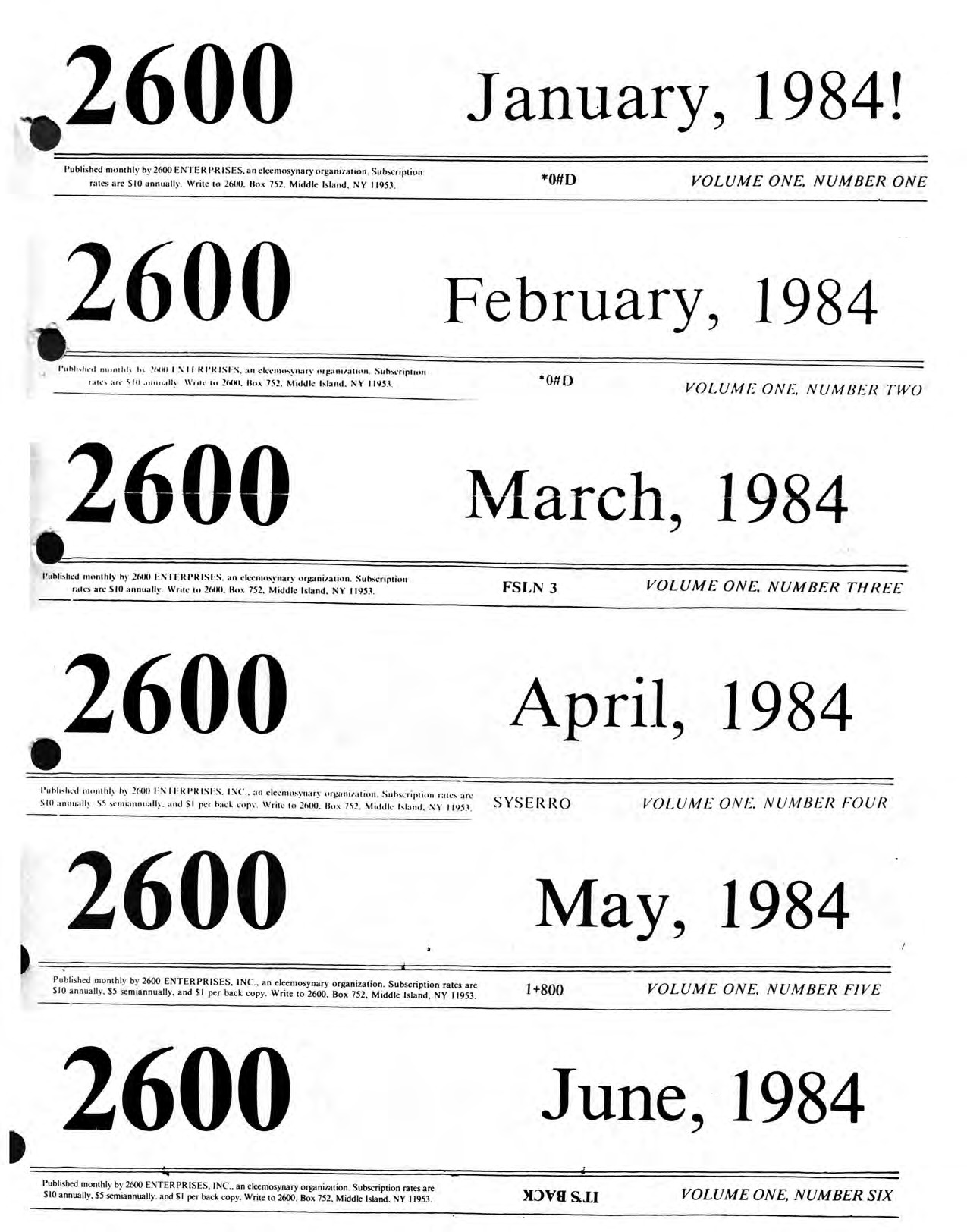
1984 was the first year of our newsletter phase, which lasted through 1986. So we didn't really have covers in the traditional sense. We did, however, try to have as much fun as we could with our masthead. Here you can trace the evolution as we started to experiment with new things.
As evidenced in the really tiny print, we originally had expected to be a nonprofit organization. That wound up being a whole lot more involved than we wanted to get and the wording was dropped in future years.
In April, we actually thought of selling back issues for the first time, and that option, along with a half-year subscription, was added.
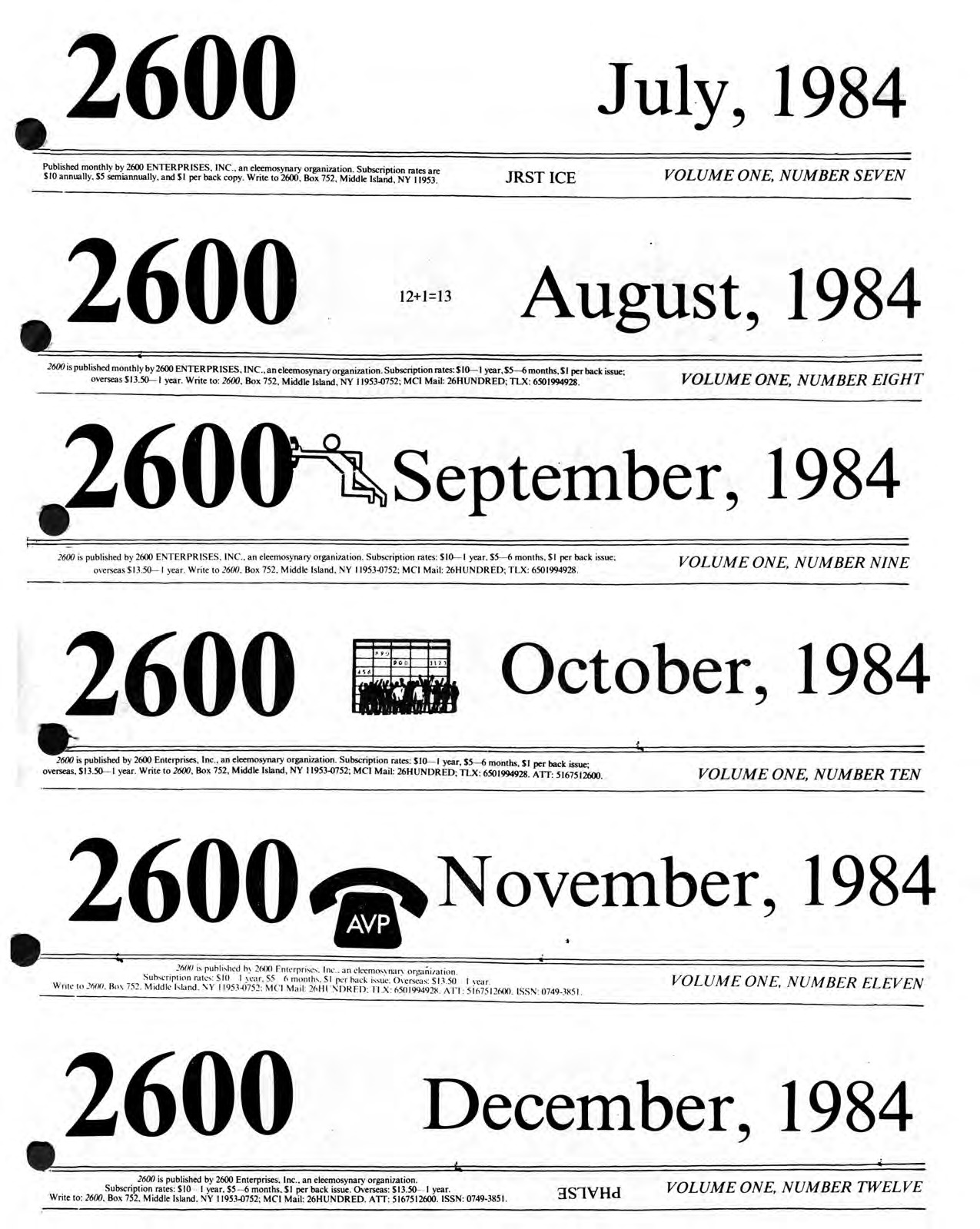
In August, we started to get international interest, and so an overseas rate was added to the masthead. We also started to use our full nine-digit ZIP Code with enthusiasm, and added our MCI Mail address along with a Telex number that came with our Western Union EasyLink account. (We never received a single Telex and we stopped listing it in December.)
It wasn't until October that we finally opened an office and got a phone number.
In November, we were assigned an ISSN number and began to think that maybe we'd stick with this publishing thing for a while.
Our very first issue began with an exclamation point after the date, to emphasize our spirit of defiance and surprise that we actually made it to publication. (A federal hacking investigation in 1983 had almost derailed the entire thing.) And, of course, it was fun to finally see the year 1984 arrive. The exclamation point for the first issue of the year would become a tradition. (Interestingly, our first story also had an exclamation point in its one word title.)
The overall look of the masthead was fairly traditional, with the name 2600 off to the left in Times Bold, a generic month and year to the right, and the volume and number in all caps and italics below that.
This left a little space in the middle for us to play with, something which quickly grew out of control.
It started with a simple reference to the bottom row of an expanded Touch-Tone phone (*0#D), the D only being found on military phones and Silver Boxes. This was how we filled the space for the first two issues.
After that, "FSLN 3" was a reference to the Sandinista revolutionary party of Nicaragua, as well as the album Sandinista! by The Clash, which had an "FSLN 2" catalog number on the side.
In April, "SYSERRO" was a pun on what looked like a computer system error and the Roman philosopher Cicero.
May saw a reference to "1+800" numbers, which were the salvation of many a phone phreak at the time. Back then, not only were 800 numbers free of charge, but they didn't ever trace your number! It was the best of all worlds.
In June, the upside down message of "IT'S BACK" referred to the return of the legendary OSUNY hacker BBS, which had been down for some time.
In July, it was another play on words with "JRST ICE" being an instruction on the PDP-10 computer (the JRST part, anyway), with the entire thing sounding suspiciously like "justice." (Even then, we had heard of the concept.)
We're sure that the "12+1=13" note in the August issue meant something significant at the time, but we can't find anyone who remembers this one.
In September, we started to make use of graphics on the front page, with a clip-art guy holding a phone and leaning on our name.
The little crowd of people staring at a board on the front of the October issue just might have been a reference to the 55th anniversary of the stock market crash.
The November issue had a clip-art telephone with the initials AVP on it, which may have been a reference to something within IBM or possibly the government.
Finally, our December issue had the upside down word "PHALSE," a clear reference to the hacker group "Phreakers, Hackers, And Laundromat Service Employees," which were the people who got together to form 2600 back in 1983. They also caused the federal authorities to investigate a possible connection between hackers and laundromats, even though the group name was only used in order to make the acronym look and sound cool.
2600 Flash
The very first issue of 2600 had a news section that was called "2600 Flash." The collection of stories, and the commentary that often went along with them, quickly became one of the more popular parts of the publication and it appeared in every issue of 1984. Stories were gathered from a variety of sources and, in some cases, investigated by 2600 staffers under the credit of "2600 News Service," "Word of Mouth," or even "A Friendly Information Operator." On one occasion in June, a story that hit particularly close to home ("2600 Writer Indicted") was made bold and surrounded by a box.
Letters
We got our first letter to the editor in our second issue (February), which is really the quickest we could have possibly gotten one. Still, it took a while for what eventually became our all-time most popular feature to catch on. The next letters weren't printed until June and from that point they appeared every month. During our newsletter phase of 1984-1986, letters were confined to a single page or less. Who knew back then how much they would grow afterwards?
Page 5
The idea behind "Page 5" was to simply print data of one sort or another, often without explanation, on a regular basis. In 1984, data was precious and many of us lived for information. Sometimes we were real wise guys about it, printing a supposedly sensitive White House phone list as a tutorial on how to properly use tabs. Other times, we printed things that today wouldn't seem like a big deal (a list of all of the country codes in the world or dial-up numbers to various corporate services), but we were information-hungry back then and there weren't a whole lot of places to go to get this sort of thing. A list of networks on the Defense Data Network was something most people hadn't a clue about, but it sure sounded interesting. We also took a bit of flack for printing a bunch of old ads from telephone books on a couple of occasions. Looking back, we think they've aged rather well.
"Page 5" usually continued onto the sixth and last page, but there were occasions when some other graphic or article would appear there instead. The feature appeared in every 1984 issue except July, when we ran a special article on TRW access. However, the "Page 5" title was left in and the article was presented as if it were data in the original run. We don't know what we were thinking.