How to Use the Dial Telephone
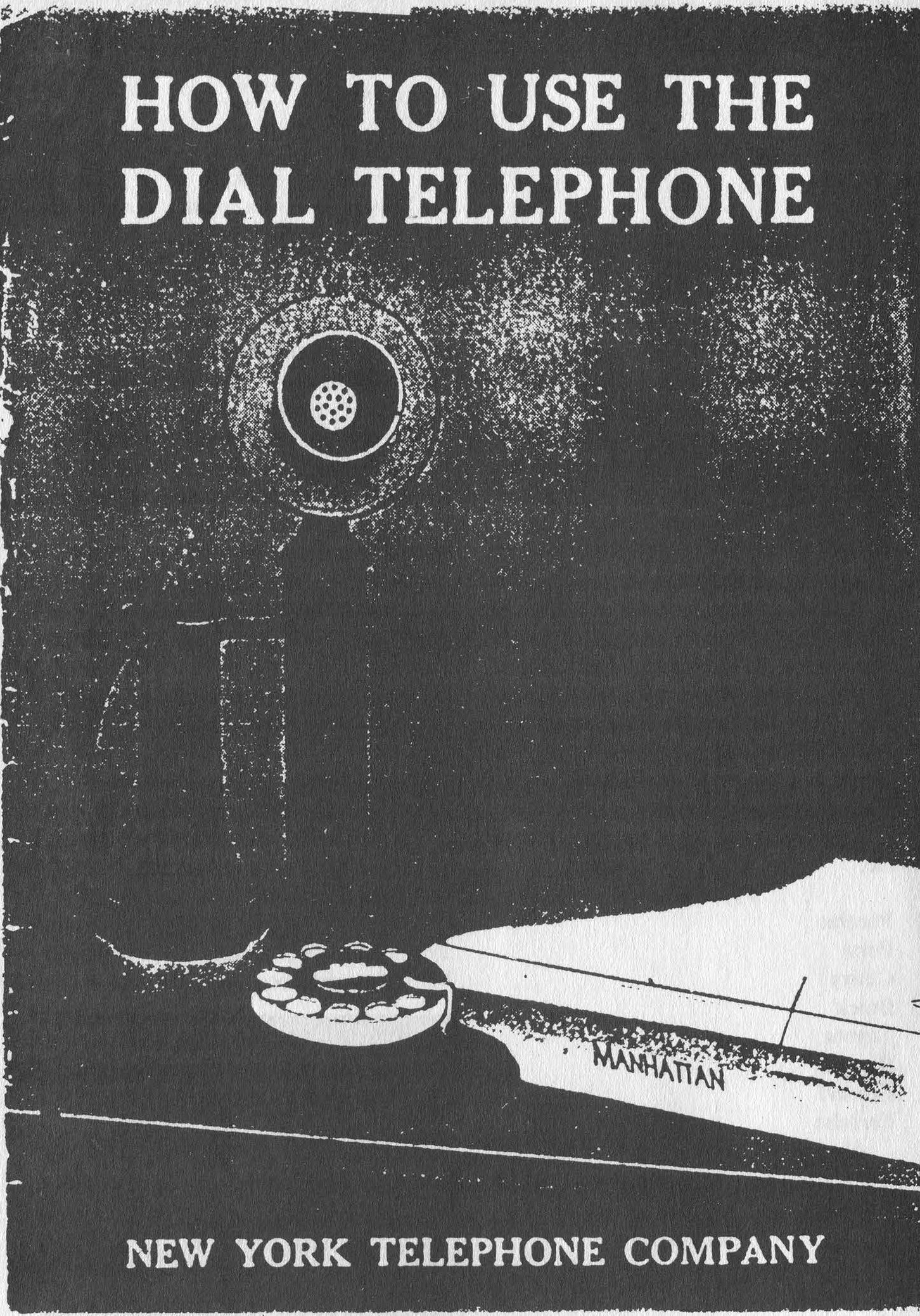
You will find the dial telephone easy to operate and the service it provides fast and dependable. The information in the following pages will be helpful to you in obtaining the utmost satisfaction and convenience in the use of dial service.
New York Telephone Company
Listening for Dial Tone
On all calls, remove the receiver from the hook and listen for dial tone before starting to dial. Dial tone is a steady humming sound in the receiver indicating that the line is ready for you to dial.
Calls to Central Offices Which You Should Dial Direct
(Central offices which you should dial direct from your telephone are shown on the card furnished to you.)
When you hear dial tone, keep the receiver off the hook and dial the first two letters of the central office name, the office numeral, then each figure of the line number.
For example, if dialing WOrth 2-9970:
1.) Place your finger in the opening in the dial over the letter W.
2.) Pull the dial around until you strike the finger stop.
3.) Remove your finger from the opening, and without touching the dial allow it to return to its normal position.
4.) Proceed in the same way to dial the letter O and the figures 2-9-9-7 and 0.
If the number called has a party line letter, dial the number in the same way, followed by the letter at the end of the number.
Within a few seconds after you have completed dialing, you should hear either the ringing signal, an intermittent burr-rr-ing sound, or the busy signal, a rapid buzz-buzz-buzz.
If you hear an interrupted buzzing sound, as buzz-buzz - buzz-buzz, it indicates that you have dialed the central office designation incorrectly. Hang up the receiver, wait a few seconds, and make another attempt, being careful to dial the central office designation correctly.
If you do not hear any signal within half a minute, hang up the receiver, wait a few seconds and make another attempt.
When, for any reason, you do not obtain a connection (for example, the called line is busy or does not answer), you will get quicker service if you hang up the receiver and try the call again yourself at intervals instead of immediately calling the operator for assistance. No charge is made unless you obtain an answer from a subscriber's telephone.
If you make a mistake while dialing, hang up the receiver at once, wait a few seconds, and make another attempt.
Before starting to dial a second call, always hang up your receiver for a few seconds.
Obtaining Assistance from the Operator
If you have trouble in dialing, or if you have occasion to report cases of service irregularities, you can reach the operator by placing your finger in the opening in the dial over the word "OPERATOR" and then pulling the dial around until you strike the finger stop.
After connection has once been established with the operator, you may recall her by moving your receiver hook up and down slowly. This can be done only when you are connected with the operator; on other calls, moving the receiver hook will break the connection.
Calls from a Party Line or from a Line with an Extension Telephone
Always make sure that the line is not in use. If you do not hear the dial tone, inquire if the line is being held by some other person. If no response is received, hang up the receiver for a few seconds and make another attempt.
Listen on the line while dialing, and if you hear another party come in on the line or hear successive clicks in the receiver, it indicates that someone else on your line is trying to call. inform him that the line is in use and request him to hang up his receiver. When he does so, hang up your own receiver for a few seconds, and then remove it and dial the complete number again.
To call another party on your line, dial the operator, give her the number you wish to call, state that it is the number of another party on your line, and give her your number.
To call an extension telephone on your line, dial the operator, give her your number and ask her to ring the extension telephone.
Calls by Number to Central Offices Which You Can Not Dial Direct
To place calls by number to central offices within New York City which you can not dial direct, or to central offices at nearby points, dial the operator and give her the number of the telephone with which you desire to be connected, and also the number of the telephone from which you are calling.
Example: "Bayside 9-5570 - Walker 5-9970"
If the central office you are calling is not at a nearby point, give the operator the name of the city, the name of the state, if desirable, the number of the telephone with which you desire to be connected, and also the number of the telephone from which you are calling.
Example: "Philadelphia, Market 1234 - Walker 5-9970" or "Portland, Maine, Preble 1234 - Walker 5-9970"
Out-of-Town Calls to Particular Persons
To make out-of-town calls to particular persons, dial the figures 2-1-1 and give the operator who answers the name of the person with who you wish to speak, the name of the city, the name of the state, the number of the telephone with which you desire to be connected, and also the number of the telephone from which you are calling.
For example: "Mr. Paul Smith at Boston, Massachusetts, Main 3340 - Walker 5-9970"
Information Calls
Telephone numbers of subscribers not listed in your directory, and telephone numbers of subscribers at out-of-town points may be obtained by calling Information.
To call Information, dial the figures 4-1-1.
Telegrams
To send a telegram, look up the telephone number of the desired telegraph company in the directory, and dial this number as you would any other.
Calls to the Telephone Company
Repair Service... Dial the figures 6-1-1
Business Office... Dial the figures 8-1-1
Time of Day... Dial MEridian 7-1212
Emergency Calls (Police, Fire, Ambulance)
Dial the operator, give her your number and say:
"I want a policeman."
"I want to report a fire."
"I want an ambulance."
If compelled to leave the telephone before the desired station answers, tell the operator where help is required.
You may also reach the Police and the Fire Departments directly by dialing the numbers listed in the directory.
Dial Coin Telephones
The operation of dial coin telephones is quite similar to that of your own dial telephone. The only differences are that it is necessary to deposit a coin in order to obtain dial tone (indicating that the line is ready for you to dial) and that telegrams are sent by dialing the operator and telling her the telegraph company desired. If the called line is busy or does not answer, the coin will be returned after the receiver is hung up.