3.3.1. Poynting's Theorem (Energy Conservation Theorem)
 (Equation 3.35)
where
 E · E is the energy stored in the E-field at a given point in V
 H · H is the energy stored in the H-field at a given point in V.
A closed surface is any surface that completely encloses a volume. The integral over the volume V corresponds to a sum of the terms in the integrand over all points inside V. Thus the integral over V corresponds to the total energy inside V possessed by all charged particles and that stored in the E- and H-fields. The term on the left, then, is the time rate of change of the total energy inside V, which is total power. The term on the right is an integral over the closed mathematical surface enclosing V. For convenience, let
P = E x H (Equation 3.36)
Figure 3.27.
A volume (V) bounded by a closed surface (S). dS is the differential surface vector. P ·dS is the projection of P on dS, which corresponds to power passing out through dS.
 (Equation 3.37)
where the brackets designate the time average of the quantity inside. Equation 3.37 states that the sum of the average power possessed by charged particles in V and the total average power passing out through S is always equal to zero. Equation 3.38 shows this relationship in another way:
 (Equation 3.38)
The term on the left is the total average power passing in through S, which is equal to the total average power transferred to the charged particles in V. Thus, if interpreted properly with respect to a closed surface, the Poynting vector E x H can be a useful parameter in describing radiation fields, but it must be used with considerable caution. Some examples will help clarify this point.
P= E2 /377 (Equation 3.39)
When the incident fields impinge on the absorber, E- and H-fields are scattered by the absorber. Poynting's theorem applied to this situation gives
 (Equation 3.40)
Since
 (Equation 3.41)
integrating Ei x Hi, the Poynting vector for the incident wave, over S would not give the total power transferred from the incident wave to the absorber. Finding this total power from integration of the Poynting vector over S would require knowing the scattered fields and including them in the calculation according to Equation 3.40. Calculating the scattered fields is generally very difficult. It is true that the power transferred to the absorber would be proportional to the Poynting vector of the incident planewave. For a given absorber and a given planewave, for example, the power transferred to the absorber would be twice as much if the incident-power density (Poynting vector of the incident wave) were 2 mW/cm2 as it would if that density were 1 mW/cm2. The actual amount of power transferred to the absorber in each case, however, would depend on the characteristics of the absorber. Thus although the incident-power density of planewaves is commonly used to indicate their ability to cause power absorption in objects they irradiate, this is only a relative indication, not an absolute one.
Figure 3.28.
A planewave irradiating an absorber. S is a closed surface used with Poynting's theorem. Scattered fields are produced by the incidence of the planewave on the absorber.
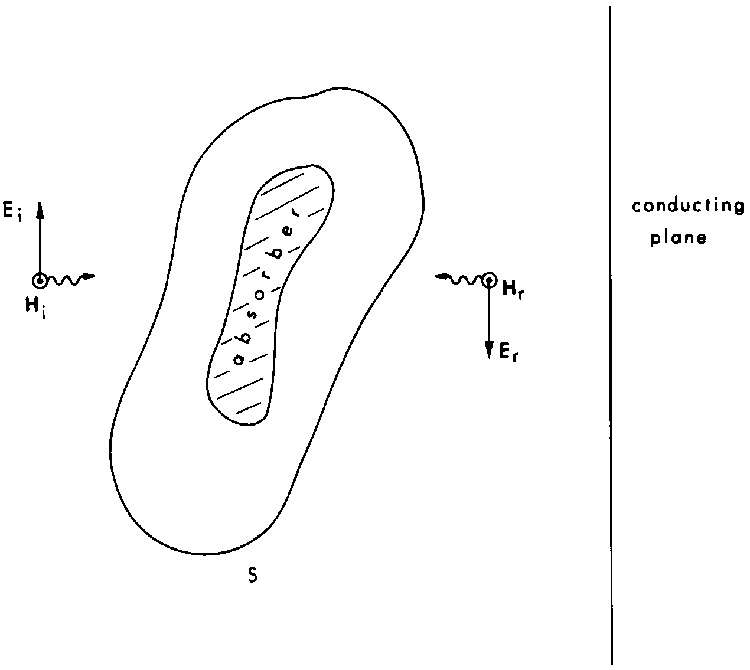
 /2 from the reflector shows the incorrectness of this procedure. As explained later (Section 3.3.2 and Figure 3.32), the total H at that distance is zero. A calculation of P based on the total E and H at that distance would therefore give a value of zero for P, which does not make sense.
Figure 3.29.
Absorber placed between an incident planewave and a conducting plane.
3.3.2. Interaction of Fields with Objects
 (Equation 3.42)
 (Equation 3.43)
 (Equation 3.44)
 (Equation 3.45)
where subscript n stands for the component of E or H normal (perpendicular) to the boundary, and subscript p stands for the component parallel to the boundary. Subscripts 1 and 2 stand for the two different materials, as indicated in Figure 3.30 for two dielectrics. In each case the field is the total field in the material, which may consist of the fields in both an incident and a reflected wave. These relations hold only at the boundary; with distance away from it, the fields may vary rapidly.
Figure 3.30.
Electric-field components at a boundary between two materials.
Figure 3.31.
Planewave incident on a planar conductor. The conductor produces a scattered wave.
Figure 3.32.
Total fields, incident plus scattered.
(a) Total E-field as a function of position at two times, t1 and t2.
(b) Total E-field as a function of position at various times through a full cycle, and the envelope of the
standing wave.
(c) Total H-field as a function of position at various times through a full cycle, and the envelope of the
standing wave.
Figure 3.33.
Planewave obliquely incident on a planar conductor.
" of the dielectric. For large ", the transmitted wave does not penetrate very far into the dielectric.
Figure 3.34.
Planewave obliquely incident on a planar dielectric.
3.3.3. Electrical Properties of Biological Tissue
' and " for the human body as a function of frequency. Calculations have shown that the average ' and " for the whole human body are equal to approximately two-thirds that of muscle tissue. At frequencies below about 1 MHz, body tissue is anisotropic; i.e., conductivity in one direction is significantly different from the conductivity in another direction.
" represents mostly ionic conductivity and absorption due to relaxational processes, including friction associated with the alignment of electric dipoles and with vibrational and rotational motion in molecules.
3.3.4. Planewave Absorption Versus Frequency
 m (Equation 3.46)
where f is the frequency in MHz. Figure 3.36 shows skin depth as a function of frequency for a planar dielectric with a permittivity equal to two-thirds that of muscle tissue (see Figure 3.35).
Figure 3.35.
Average permittivity of the human body (equivalent to two-thirds that of muscle tissue) as a
function of frequency.
At higher frequencies, the skin depth is very small; thus most of the energy from the fields is absorbed near the surface. For example, at 2450 MHz the skin depth is about 2 cm; at 10 GHz, about 0.4 cm.
Figure 3.36.
Skin depth versus frequency for a dielectric half-space with permittivity equal to two-thirds that of muscle.
3.3.5. Polarization
Polarization for objects of revolution (circular symmetry about the long axis) is defined by the incident-field vector--E, H, or k -- parallel to the long axis of the body. The polarization is called E polarization if E is parallel to the long axis, H if H is parallel, and K if k is parallel. This definition is illustrated in terms of prolate spheroids in Figure 3.37.
Figure 3.37.
Polarization of the incident field with respect to an irradiated object.
Figure 3.38.
Polarization for objects that do not have circular symmetry about the long axis.
3.3.6. Specific Absorption Rate
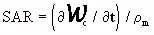 (Equation 3.47)
where  m is the mass density of the object at that point. For sinusoidal fields, the time-average SAR at a point is given by the term <Pc> / m in Equation 3.38. This is also called the local SAR or SAR distribution to distinguish it from the whole-body average SAR. The average SAR is defined as the time rate of change of the total energy transferred to the absorber, divided by the total mass of the body. From Poynting's theorem for the time-average sinusoidal steady-state case (see Equation 3.38), the whole body average SAR is given by
 (Equation 3.48)
where M is the total mass of the absorber. In practice, the term "whole-body average SAR" is often shortened to just "average SAR."
 (Equation 3.49)
Thus if the E-field and the conductivity are known at a point inside the object, the SAR at that point can easily be found; conversely, if the SAR and conductivity at a point in the object are known, the E-field at that point can easily be found. Traditionally P has been called absorbed-power density, and the relation in Equation 3.49 illustrates why SAR is also called absorbed power density. The bioelectromagnetics community, however, has generally accepted SAR as the preferred term.
Figure 3.39.
Calculated whole-body average SAR frequency for model of an average man for three standard polarizations. The incident-power density is 1 mW/cm2.
Figure 3.40.
Calculated whole-body average SAR versus frequency for model of a medium-sized rat for three standard polarizations. The incident-power density is 1 mW/cm2
- The SAR is higher when the incident E-field is more parallel to the body than perpendicular.
- The SAR is higher when the cross section of the body perpendicular to the incident H-field is larger than when it is smaller.

Go to Chapter 3.4
Return to Table of Contents.
Last modified: June 24, 1997
© October 1986, USAF School of Aerospace Medicine, Aerospace Medical Division (AFSC), Brooks Air Force Base, TX 78235-5301
This is a Department of Defense computer system for authorized use only. DoD computer systems may be monitored for all lawful purposes, including to ensure that their use is authorized, for management of the system, to facilitate against unauthorized access, and to verify security procedures, survivability, and operational security. Using this system constitutes consent to monitoring. All information, including personal information, placed on or sent over this system may be obtained during monitoring. Unauthorized use could result in criminal prosecution.
POC: AFRL/HEDM, (210)536-6816, DSN 240-6816