5.1.3. Sensitivity of SAR Calculations to Permittivity Changes
5.1.4. Relative Absorption Cross Section
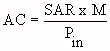 (Equation 5.25)
where Pin is the incident power density and M is the mass of the object exposed to EM fields.
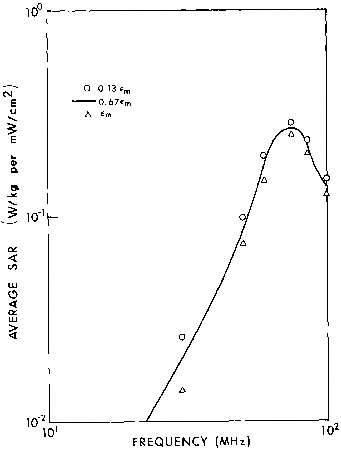
Figure 5.7.
Calculated average SAR in a prolate
spheroidal model of an average man, as a function of
frequency for several values of permittivity.  m is the
permittivity of muscle tissue.
m is the
permittivity of muscle tissue.
 a2 for a sphere of radius a). The RAC is a
dimensionless number and is a measure of the object's ability
to absorb EM energy. For an arbitrarily shaped body, the RAC
depends on the orientation of the body with respect to the
polarization of the EM fields. In terms of the average SAR,
it can be expressed as
a2 for a sphere of radius a). The RAC is a
dimensionless number and is a measure of the object's ability
to absorb EM energy. For an arbitrarily shaped body, the RAC
depends on the orientation of the body with respect to the
polarization of the EM fields. In terms of the average SAR,
it can be expressed as
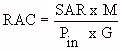 (Equation 5.26)
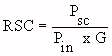 (Equation 5.27)
Figure 5.8.
Relative absorption cross section in prolate
spheroidal models of an average man, a rabbit, and a
medium-sized rat--as a function of frequency for E
polarization.
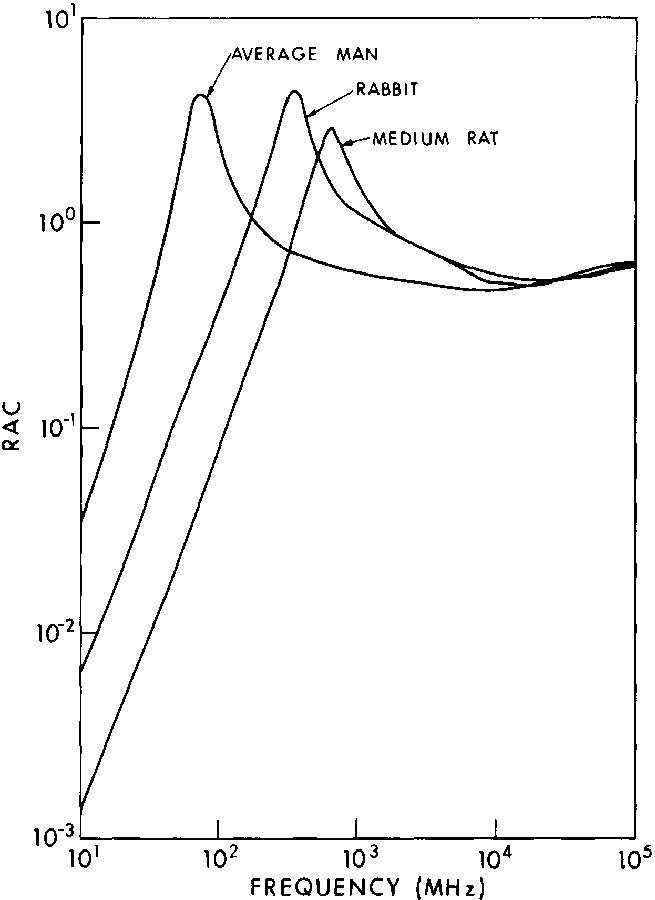
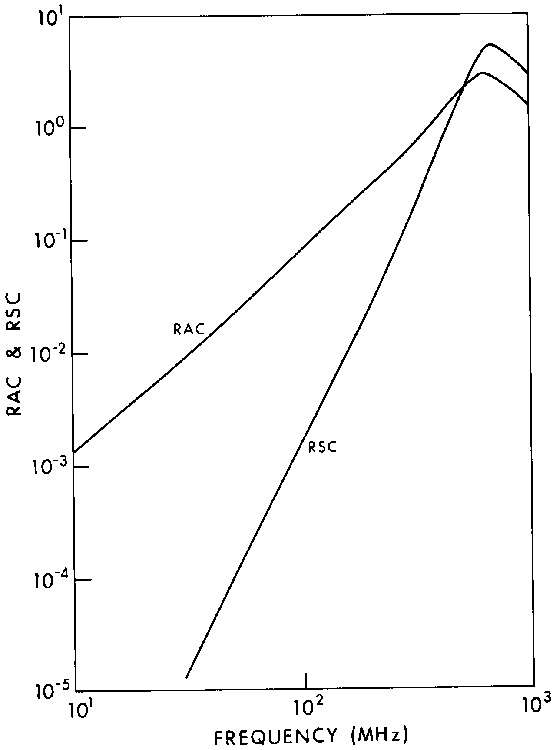
Figure 5.9.
Comparison of relative scattering cross
section (RSC) and relative absorption cross section (RAC) in
a prolate spheroidal model of a medium rat--for planewave
irradiation, E polarization.
5.1.5. Qualitative Dosimetry
E1p = E2p (Equation 5.28)
1E1n = 2E2n (Equation 5.29)
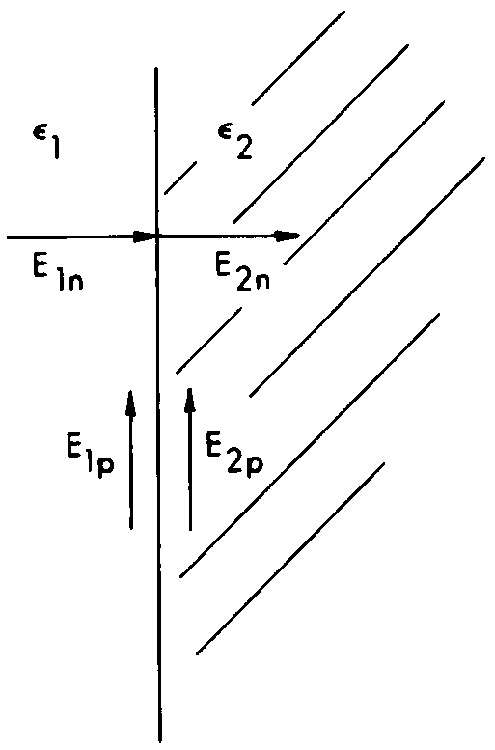
where Elp and E2p are components parallel to the
boundary, and Eln and E2n are component, perpendicular to the
boundary, as shown in Figure 5.10. It is important to
remember that Equations 5.28 and 5.29 are valid only at a
point on the boundary. From Equation 5.29, we can see that
E2n = 1 Eln /2; and if 2 >> 1, then E2n << E1n. Thus if Eln is the field in free space and E2n is the field in an absorber, the internal field at the boundary will be much weaker than the external field at the boundary when 2 > > 1 and the fields are normal to the boundary. Also, from Equation 5.28, we see that the external field and the internal field at the boundary are equal when the fields are parallel to the boundary. These two results will be used extensively in explaining relative energy absorption.
Figure 5.10.
Field components at a boundary between two media having different complex permittivities, 1 and 2.
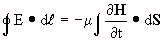
 = o ) and have no significant effect on the H-field
itself at the boundary. Another relation between the incident
H-field and the internal E-field, however, is useful in
explaining qualitatively the relative strengths of internal
fields.
= o ) and have no significant effect on the H-field
itself at the boundary. Another relation between the incident
H-field and the internal E-field, however, is useful in
explaining qualitatively the relative strengths of internal
fields.
 (Equation 5.30)
For the very special case of a lossy dielectric cylinder
in a uniform H-field Equation 5.30 can be solved by deducing
from the symmetry of the cylinder and fields that E will have
only a  component that will be constant around a circular
path, such as the one shown dotted in Figure 5.11. For E
constant along the circular path, and H uniform, Equation
5.30 reduces to
component that will be constant around a circular
path, such as the one shown dotted in Figure 5.11. For E
constant along the circular path, and H uniform, Equation
5.30 reduces to
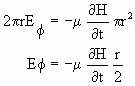 (Equation 5.31)
Thus, Equation 5.30 shows that E is related to the rate of change of the magnetic flux intercepted by the object; and Equation 5.31 shows that for the very special case of Figure 5.11, the E-field circulates around the H-field and is directly proportional to the radius. For this example the circulating E-field (which produces a circulating current) would be larger for a larger cross section intercepted by the H-field. The generalized qualitative relation that follows from Equation 5.30 is that the circulating field is in some sense proportional to the cross-sectional area that intercepts the H-field. This result is very useful in qualitative explanations of relative energy absorption characteristics; however, this qualitative explanation cannot be used indiscriminantly.
Figure 5.11.
A lossy dielectric cylinder in a uniform magnetic field.
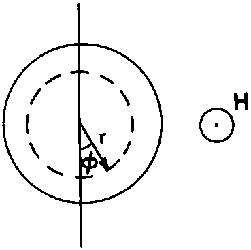
Ein = E e+ Eh (Equation 5.32)
where
QP1.
Ee is stronger when Einc is mostly parallel to the boundary of the object and weaker when Einc is mostly perpendicular to the boundary of the object.
QP2.
Eh is stronger when Hinc intercepts a larger cross section of the object and weaker when Hinc intercepts a smaller cross section of the object.
Figure 5.12.
Qualitative evaluation of the internal
fields based on qualitative principles QPl and QP2. Ee
is the internal E-field generated by Einc, the
incident E-field, and Eh is the internal
E-field generated by Hinc,the incident
H-field.
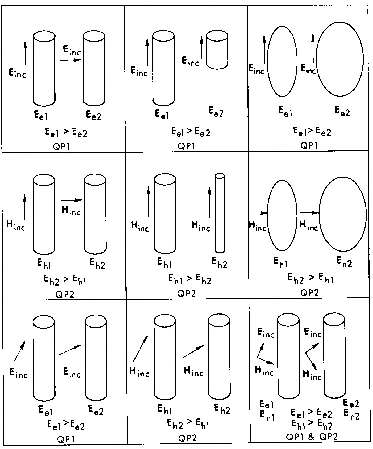
Table 5.1
Application of QP1 and QP2 To Planewave SARS
 /d)2 , since the magnitude of the E- and H-fields is expected to
increase more rapidly than /d in the near-field region.
However, the reasons for the shape of the SAR curve may be
found from Figure 8.21, which shows the behavior of the
measured fields of the antenna (designated Einc and
Hinc with respect to an absorber). The direction of
the Hinc does not change with d, but the magnitude of
Hinc increases faster than /d for d/ < 0.3. The
direction of Einc however, changes significantly with
d. In the far field, the angle
/d)2 , since the magnitude of the E- and H-fields is expected to
increase more rapidly than /d in the near-field region.
However, the reasons for the shape of the SAR curve may be
found from Figure 8.21, which shows the behavior of the
measured fields of the antenna (designated Einc and
Hinc with respect to an absorber). The direction of
the Hinc does not change with d, but the magnitude of
Hinc increases faster than /d for d/ < 0.3. The
direction of Einc however, changes significantly with
d. In the far field, the angle  between Einc and the
long axis of the spheroid is zero; but at d/ = 0.1, it is
about 70º. According to QP1, this change in angle has a
significant effect on Ee Thus the change in SAR with
d/ results from three factors:
between Einc and the
long axis of the spheroid is zero; but at d/ = 0.1, it is
about 70º. According to QP1, this change in angle has a
significant effect on Ee Thus the change in SAR with
d/ results from three factors:
- Ee increases as the magnitude of Einc increases.
- Ee decreases as increases.
- Eh increases as the magnitude of Hinc increases.
/d, Ee increases much more slowly than /d because of the
combination of factors 1 and 2. The average SAR, which is
proportional to E2in does not increase as fast as (/d)2
because Ee affects Ein more than Eh
does. On the other hand, since the monkey-size spheroid is
relatively shorter and fatter than the man-size spheroid,
Eh has a stronger effect on Ein for the monkey
than for the man. Consequently, the SAR for the monkey
increases more rapidly as d decreases than does the SAR for
the man.
. The reasons for this
can be seen from Figures 6.37 - 6.39:
- Einc is slightly lower at 200 MHz and significantly lower at 300 MHz than at the other frequencies.
- Hinc is lower at 200 and 300 MHz than at the other frequencies.
- The angle of Einc with the z axis is
significantly higher at 200 and 300 MHz than at the other
frequencies.
. According to QP1, as increases, the SAR
decreases. The effect of can be seen from the 300-MHz
curve which begins to rise rapidly at y/ = 0.3, where
decreases steeply. A surprising aspect of the correspondence
between incident-field characteristics and the relative SAR
characteristics is that the correlation was based on the
values of the incident fields at only one point in space.
/y (as shown in Figure 6.37) for
0.15 < y/ < 0.5 is slower than /y, the relative
SARs for an absorber at distance d from the dipole for both H
and K polarizations vary faster than (/d)2 in this region
(as seen in Figures 6.32 and 6.33). From the nature of the
incident fields (as shown in Figures 6.37-6.39), Eh
appears to dominate for K and H polarizations, while
Ee dominates for E polarization. The same behavior is
shown in a different way in Figure 5.13, where the calculated
average SAR for a prolate spheroidal model of an average man
is shown as a function of  = Einc/o Hinc ,
the normalized field impedance, with Einc constant at
1 V/m. The curves show the characteristic behavior that
results when the impedance deviates from the planewave case
( = 1). Since Einc is constant, small means large
Hinc ; thus, for a very small , Hinc
dominates and E polarization and K polarization become
equivalent.
< 1.5, which, according to Figure
6.40, is the range of interest. This means that the
contribution of the Hinc to the average SAR dominates for K
and H polarizations, while the contribution of the Einc
dominates for E polarization, as explained by Durney et al.
(1975) and in the report by the National Council on Radiation
Protection and Measurements (1981). Thus, for K and H
polarization, the SAR in the long-wavelength region follows
the Hinc variation and therefore lies above the (/d)2
variation, as shown in Figures 6.32 and 6.33.
= Einc/o Hinc ,
the normalized field impedance, with Einc constant at
1 V/m. The curves show the characteristic behavior that
results when the impedance deviates from the planewave case
( = 1). Since Einc is constant, small means large
Hinc ; thus, for a very small , Hinc
dominates and E polarization and K polarization become
equivalent.
< 1.5, which, according to Figure
6.40, is the range of interest. This means that the
contribution of the Hinc to the average SAR dominates for K
and H polarizations, while the contribution of the Einc
dominates for E polarization, as explained by Durney et al.
(1975) and in the report by the National Council on Radiation
Protection and Measurements (1981). Thus, for K and H
polarization, the SAR in the long-wavelength region follows
the Hinc variation and therefore lies above the (/d)2
variation, as shown in Figures 6.32 and 6.33.
Figure 5.13.
Average SAR in a prolate spheroidal model of
an average man as a function of normalized impedance for each
of the three polarizations. (a = 0.875 m, b = 0.138 m, f =
27.12 MHz,  = 0.4 S/m, incident E-field is 1
V/m.)
= 0.4 S/m, incident E-field is 1
V/m.)
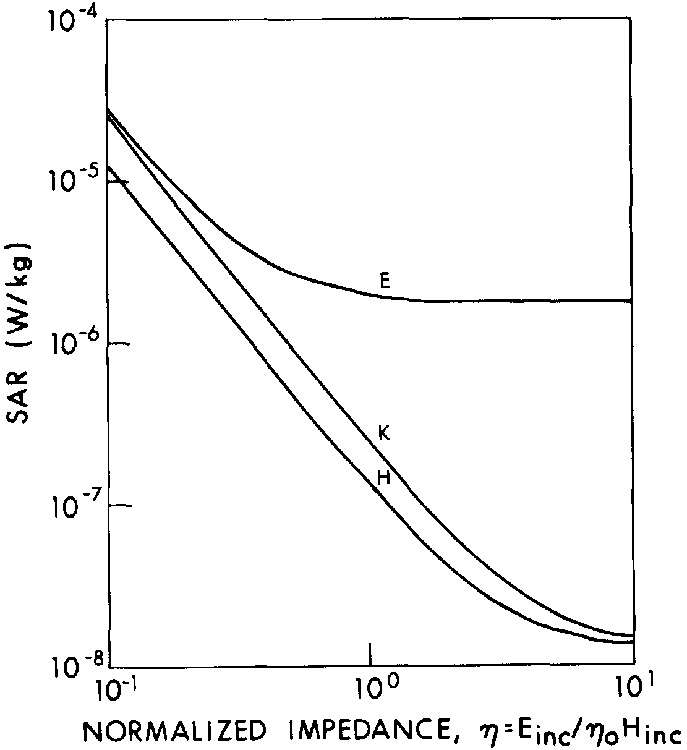
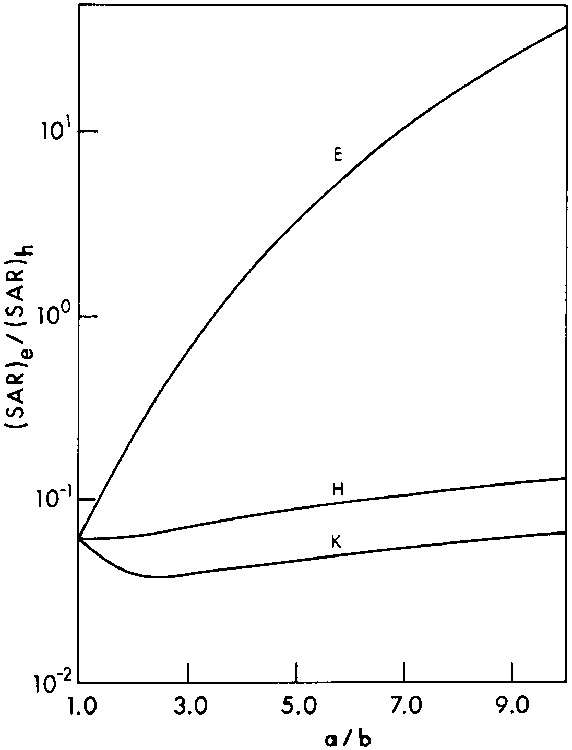
Figure 5.14.
Ratio of (SAR)e, to (SAR)h of a 0.07-m3
prolate spheroid for each polarization as a function of the
ratio of the major axis to the minor axis of the spheroid at
27.12 MHz, = 0.4 S/m.

Go to Chapter 5.2
Return to Table of Contents.
Last modified: June 14, 1997
© October 1986, USAF School of Aerospace Medicine, Aerospace Medical Division (AFSC), Brooks Air Force Base, TX 78235-5301
This is a Department of Defense computer system for authorized use only. DoD computer systems may be monitored for all lawful purposes, including to ensure that their use is authorized, for management of the system, to facilitate against unauthorized access, and to verify security procedures, survivability, and operational security. Using this system constitutes consent to monitoring. All information, including personal information, placed on or sent over this system may be obtained during monitoring. Unauthorized use could result in criminal prosecution.
POC: AFRL/HEDM, (210)536-6816, DSN 240-6816