 text
version
text
versionPentOpt ProfessionalTM is an assembly language source code optimization tool for the Intel Pentium® and 486 processors.
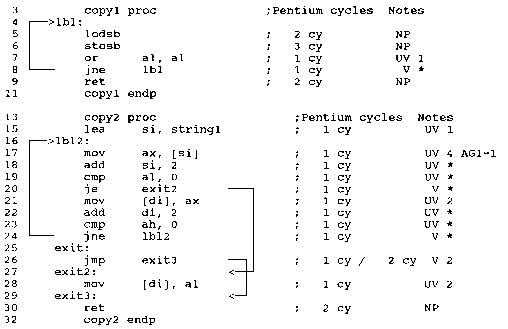
PentOpt analyzes your code and produces annotated flow charts with all the information you need to schedule instructions for maximum dual pipeline operation.
For many programmers, to see how to take advantage of all this information and of the superscalar execution capabilities of the Pentium will require some additional knowledge. So that's why,
The book is "PentiumTM Processor Optimization Tools", by Quantasm President, Mike Schmit, published by AP Professional (ISBN 0-12- 627230-1). This book describes a step-by-step method for optimizing code for superscalar execution.
The disk included with the book contains all the example source code, as well as the timing tools required to verify performance for 16-bit or 32-bit code. All this and DEBUG32, a 32-bit DPMI debugger, for only $39.95.
The book provides you with the knowledge and expertise to write fast efficient code for the Pentium and 486; and PentOpt eliminates most of the tedious work of remembering all the details of instruction pairing and pipeline stalls. But more important is that PentOpt helps isolate likely candidates for optimization in your existing code with the use of the loop summary reports.
In just a few seconds PentOpt can scan 1000's of lines of code, then you can use these reports to determine where to spend your time optimizing for maximum dual pipeline operation.
The Intel Pentium has two instruction pipelines (U and V pipes). The CPU will execute the next two instructions from the prefetch queue if certain criteria are met and the results of the first instruction are not needed for the second instruction.
PentOpt checks these conditions for you. In addition PentOpt checks for AGI's (address generation interlocks) which can cause the CPU to be delayed for a cycle. (AGI's on the Pentium are a double penalty since two execution time slots are lost.) Avoiding AGI's on the Pentium is more difficult than on the 486 because they can sometimes be caused by any of the previous three instructions vs. only the previous one on the 486. AGI's are delays inserted into the pipeline when an address used in one cycle is being calculated during the previous cycle.
start   end  nest        -Total--    -Paired--    ---Reason not paired---
 line  line depth   NP   U  V  UV    U   V  UV    NP  mis dup reg stk mem
    3    11    0     3   0  1  1     0   1   0     3   1   0   0   0   0
    4     8    1     2   0  1  1     0   1   0     3   0   0   0   0   0
   13    32    0     1   0  3  8     0   2   4     1   4   0   1   0   0
   16    24    1     0   0  2  6     0   2   4     0   1   0   1   0   0

                         Loop Summary legend

    start line  starting line of program, procedure or loop
    end line    ending line of program, procedure or loop
    nest depth  nesting depth of loop
    NP          number of instructions that are not pairable
    Total
     U    total number of instructions pairable in the U-pipe
     V    total number of instructions pairable in the V-pipe
     UV   total number of instructions pairable in the U- or V-pipe
    Paired
     U    number of U-pipe instructions that may be paired
     V    number of V-pipe instructions that may be paired
     UV   number of U- or V-pipe instructions that may be paired
    Reason not paired
     NP   previous instruction is not pairable
     mis  pipe mismatch; prev instruction not U or this instruction
    not V
     dup  duplicate register destination (write after write)
     reg  register conflict (read after write)
     stk  stack pointer register conflict
     mem  memory operand conflict


    Flow chart instruction notes (* = pairs; else reason not
    pairable):

     * = pairable with previous instruction
     1 = previous instruction is NP (Not pairable)
     2 = U and V pipe mismatch (previous not U or this one not V)
     3 = repeated register destination (write after write)
     4 = register conflict (read after write)
     5 = stack pointer or flags register conflict (read after write)
     6 = memory operand conflict (read or write after write)
     AGI n = Address Generation Interlock on instruction -n
|